Disclosing Multiple Vulnerabilities in Moog EXO Series Cameras
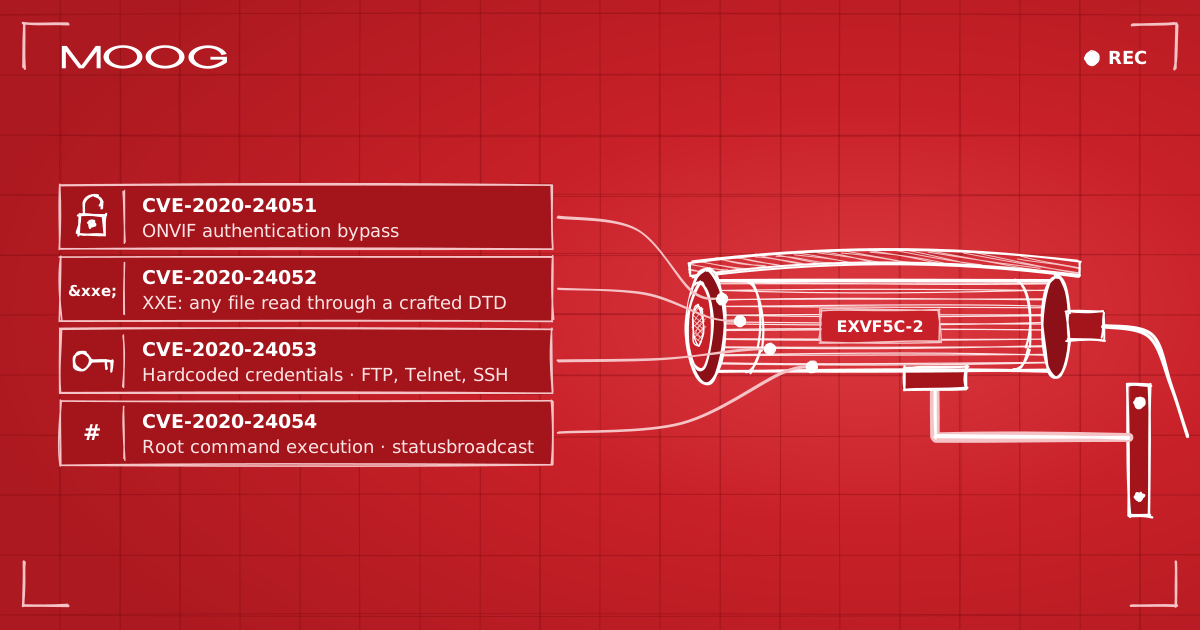
With three colleagues, I broke into Moog’s EXO cameras through four vulnerabilities, CVE-2020-24051 to 24054: an ONVIF authentication bypass, XXE, hardcoded credentials, and root command execution, disclosed with IOActive.
In May 2019, I traveled to Saudi Arabia, to its capital Riyadh, with three colleagues: Mario Ballano, Gabriel Gonzalez, and Josep Pi Rodríguez.
The Engagement
The client we were working for wanted to evaluate the security of several surveillance cameras from different manufacturers. The job had to be done on site, as we needed physical access to the cameras to assess the security of their firmware and of their web interfaces.
At the end of the engagement, we found a few vulnerabilities, some of them high risk. With the agreement of my colleagues who had found some of these security issues, I proposed writing an advisory to disclose them. Before publishing, we informed the vendors, and some of the issues led to CVEs.1234
The Advisory
This post covers the vulnerabilities we disclosed in the cameras from Moog Inc. (Moog). Moog offers a wide range of camera and video surveillance systems, network-based or part of larger tracking systems. The affected products are the EXO series,5 built for extreme temperatures, power surges, and heavy impacts. The units are configured from a web application, and they run a Unix-based operating system.6
IOActive published the advisory, Moog EXO Series Multiple Vulnerabilities, on its site and as a PDF.7 Click the cover below to open it.

The CVEs
The CVEs reported were:
- CVE-2020-24051: an authentication bypass in the ONVIF web service of the EXVF5C-28 and EXVP7C2-39 units, which lets an attacker run operations that should require a login.
- CVE-2020-24052: several XML external entity (XXE) vulnerabilities, which let a remote unauthenticated user read arbitrary files through a crafted document type definition in an XML request.
- CVE-2020-24053: hardcoded credentials, usable over FTP, Telnet, and SSH.
- CVE-2020-24054: the
statusbroadcastcommand of the administration console, which runs a given binary repeatedly asroot, so any command can be run with the highest privileges.
References
-
“CVE-2020-24051”. CVE Program, 2020. (Archive)
-
“CVE-2020-24052”. CVE Program, 2020. (Archive)
-
“CVE-2020-24053”. CVE Program, 2020. (Archive)
-
“CVE-2020-24054”. CVE Program, 2020. (Archive)
-
“EXO IP Camera Systems” (PDF). Moog, on Anixter’s site. (Archive)
-
“Moog EXO Series Multiple Vulnerabilities”. IOActive, June 2020. (Archive)
-
“Moog EXO Series Multiple Vulnerabilities” (PDF). IOActive, June 2020. (Archive)
-
“EXO Fixed HD Camera Series” (PDF). Moog, 2014, on ScanSource’s site. (Archive)