Disclosing Multiple Vulnerabilities in Verint PTZ Cameras
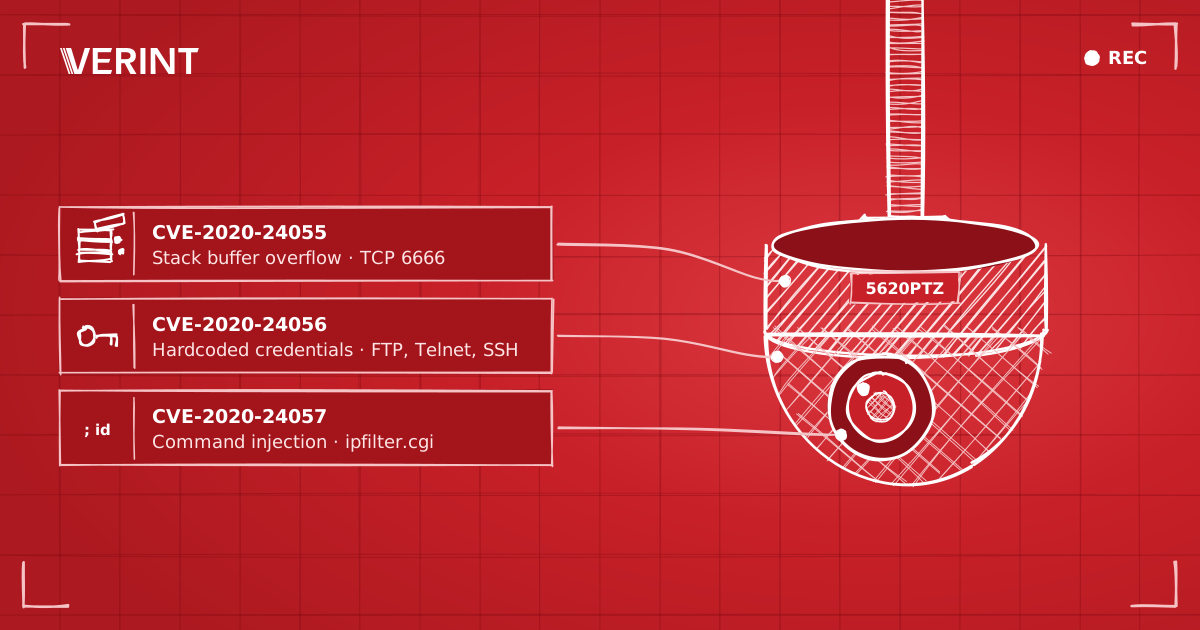
With three colleagues, I broke into Verint’s PTZ cameras through three vulnerabilities, CVE-2020-24055 to 24057: a stack buffer overflow, hardcoded credentials, and a command injection, disclosed with IOActive.
In May 2019, I traveled to Saudi Arabia, to its capital Riyadh, with three colleagues: Mario Ballano, Gabriel Gonzalez, and Josep Pi Rodríguez.
The Engagement
The client we were working for wanted to evaluate the security of several surveillance cameras from different manufacturers. The job had to be done on site, as we needed physical access to the cameras to assess the security of their firmware and of their web interfaces.
At the end of the engagement, we found a few vulnerabilities, some of them high risk. With the agreement of my colleagues who had found some of these security issues, I proposed writing an advisory to disclose them. Before publishing, we informed the vendors, and some of the issues led to CVEs.123
The Advisory
This post covers the vulnerabilities we disclosed in the cameras from Verint Systems Inc. (Verint). Verint sells software and hardware for data analysis, but also IP cameras and video systems. Most of these cameras are configured from a web application, and they run a Unix-based operating system.4
IOActive published the advisory, Verint PTZ Cameras Multiple Vulnerabilities, on its site and as a PDF.5 Click the cover below to open it.
The CVEs
The CVEs reported were:
- CVE-2020-24055: a stack buffer overflow in the autodiscovery service of the 5620PTZ6 and 43207 units, the
/usr/sbin/DMbinary listening on TCP port6666. - CVE-2020-24056: hardcoded credentials in the 5620PTZ, 4320, and S5120FD8 units, usable over FTP, Telnet, and SSH.
- CVE-2020-24057: a command injection in the
ipfilter.cgiendpoint of the S5120FD’s management website, which lets an authenticated attacker run arbitrary commands on the unit.
References
-
“CVE-2020-24055”. CVE Program, 2020. (Archive)
-
“CVE-2020-24056”. CVE Program, 2020. (Archive)
-
“CVE-2020-24057”. CVE Program, 2020. (Archive)
-
“Verint PTZ Cameras Multiple Vulnerabilities”. IOActive, June 2020. (Archive)
-
“Verint PTZ Cameras Multiple Vulnerabilities” (PDF). IOActive, June 2020. (Archive)
-
“Verint V4320FD-DN IP Camera Technical Details”. SourceSecurity.com. (Archive)
-
“Verint S5120FD-DN IP Dome Camera Technical Details”. SourceSecurity.com. (Archive)